We are pleased to announce the formation of Shades of Gray Law, P.C., a boutique law firm focusing on intellectual property and commercial prosecution, litigation, and counseling, with a particular emphasis on copyrights and trademarks. Please visit our website at shadesofgray.law.
TOPIC : Uncategorized
Shades of Grayer
Liberté, Egalité, Fraternité
Nous sommes tous Parisiens.
Have a Noninfringing Halloween
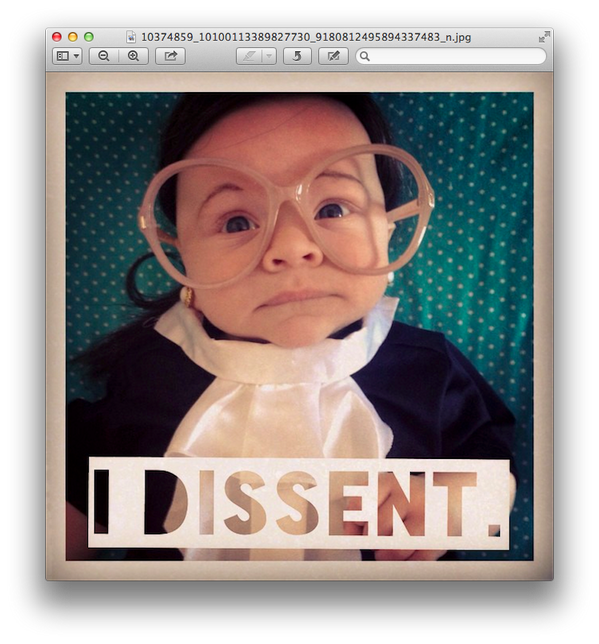
Reprinted with permission. Photo credit/copyright Kate Livingston.
In honor of Halloween and my favorite Supreme Court justice, I present Ruth Baby Ginsburg. May your Halloween be free from the horror of infringement.
So Easy a Monkey Can Do It
To the delight of copyright lawyers everywhere, yesterday the infamous Monkey Selfie debate of 2011 revived itself in the wake of a transparency report issued by Wikimedia revealing that the organization refused a request by photographer David Slater to remove the photo from Wikimedia Commons. Slater traveled to Indonesia in 2011 to photograph macaque monkeys. By Slater’s own account, a monkey grabbed one of his cameras and began snapping photos, including this one . Slater apparently licensed the image for distribution, and later discovered that it had been uploaded to the Wikimedia Commons database. He demanded that Wikimedia remove the image, and the organization refused on the ground that Slater did not create the image himself and therefore does not own copyright in it. Slater’s demand, and Wikimedia’s refusal, came to light when the organization issued its transparency report. Copyright Twitter feeds everywhere immediately lit up like a Christmas tree.

Under U.S. copyright law, the author of a work is the one who created it. In wonky copyright terms, it is the person who fixed an original expression in a tangible medium. Here, Slater has publicly admitted that he did not create the photograph; the monkey. The United States Copyright Office takes the position that only human beings can be “authors.” Animals need not apply. Accordingly, this gives rise to the somewhat unusual situation where there appears to be no author as a matter of law, and thus no copyright ownership.
Of course, U.S. copyright law generally does not apply extraterritorially, and the image in question was created in Indonesia. Although both countries are signatories to the Berne Convention, which requires member nations to give each others’ nationals equal treatment under copyright law, the question of who owns the copyright in the image in the first instance may be governed by Indonesian law.
Slater has reportedly consulted with a U.S. attorney, and is supposedly considering pursuing an infringement action.
2nd Circuit Finds the Beef – Reverses Summary Judgment Grant in YouTube
On April 5, the Second Circuit issued its highly anticipated opinion in Viacom v. YouTube, reversing the District Court’s grant of summary judgment and remanding for further proceedings. Significantly, the opinion marks the first time that a court has drawn a meaningful, substantive distinction between actual and “red-flag” knowledge under the DMCA. This sets it apart from earlier DMCA opinions, including that of the Ninth Circuit in UMG Recordings, Inc. v. Shelter Capital (involving the Veoh videosharing service) and, notably, the lower court opinion in Viacom. Practitioners and ISPs now have some judicial guidance as to how to construe their rights and responsibilities under the DMCA.
Ominously for YouTube, the Second Circuit held that a reasonable jury could find that, under DMCA Section 512(c), YouTube had actual knowledge or awareness of specific infringing activity on its website. Moreover, the Second Circuit ruled that the District Court had incorrectly construed the DMCA’s control and benefit provisions in holding that the “right and ability to control” infringing activity required that the ISP have knowledge of specific, identifiable instances of infringement. Finally, the court affirmed the District Court’s holding that three of YouTube’s software functions fell within the safe harbor for infringement occurring “by reason of user storage,” and remanded for further fact-finding with respect to a fourth software function. Continue reading
Partial verdict in Oracle v. Google – The party’s not over
Today the jury issued a partial verdict in the Oracle v. Google copyright infringement lawsuit. In that suit, Oracle accuses Google of infringing elements of its Java programming platform in developing its Android mobile software. The jury found that Google infringed 37 Java API packages. The jury did not reach a result on the issue whether Google’s use of the API packages constituted a fair use. Google is reportedly seeking a mistrial. The trial is now moving into a phase involving Oracle’s claims that Google infringed certain Java patents.
Maria
Maria Pallante appointed Register of Copyrights
Today the Librarian of Congress appointed Maria Pallante as the new Register of Copyrights. Ms. Pallante has served as Acting Register since the previous Register, Marybeth Peters, resigned in December. You can find the announcement of the appointment here.
Sharing the Love
Naomi Jane Gray joins The 1709 Blog team
I am pleased to announce that I have joined the team of The 1709 Blog, which is dedicated to “all things copyright, warts and all.” The blog takes its name from the year of passage of the Statute of Anne, the copyright act that started it all, to which I am eternally indebted for my livelihood (h/t Her Maj. Queen A.). Thanks to Jeremy Phillips, dean of the IP blogosphere, for the invitation. You can also view the announcement of my joining The 1709 Blog over at Jeremy’s sister blog, The IPKat.
I will, of course, continue to post regularly here at Shades of Gray Law, so please keep reading!
In Memoriam – Schelle Simcox
It is with great sadness that I dedicate this post to the memory of my friend and former colleague, Schelle Simcox, who passed away last weekend after a courageous struggle with cancer. Schelle was formerly a law librarian in the San Francisco office of Paul Hastings, where I had the great privilege of working with her and becoming her friend. Schelle, along with her fellow law librarian Sara Paul, inspired and encouraged me to start this blog. Schelle was not only a terrific librarian and researcher (and as the daughter of a librarian, I know a good one when I see one). More importantly, she was simply the most wonderful friend and colleague a person could have. In addition to her professional skills, she had a deep and abiding interest in midwifery, and was a tremendous resource and source of support for me during my first pregnancy. I miss you, Schelle. I will never forget you.
Statutory Damages Smackdown!
First Circuit Set to Hear Constitutional Challenge to Filesharing Award
On April 4, the First Circuit Court of Appeals will hear oral argument in Sony v. Tenenbaum, the first constitutional challenge to a statutory damages award to reach the appellate level. The case pits the recording industry against Joel Tenenbaum, who, as a college student, downloaded and made available for distribution thousands of songs using multiple filesharing services over a period of years. A group of recording companies sued Tenenbaum for infringing 30 of those songs. The trial court rejected Tenenbaum’s fair use defense and directed verdict against him. The plaintiffs elected statutory damages and the parties proceeded to a jury trial. The jury found that Tenenbaum had acted willfully and awarded the plaintiffs $22,500 per song, for a total verdict of $675,000.
Tenenbaum moved for a new trial, arguing that the statutory damages award was unconstitutionally excessive as applied. Alternatively, he sought remittitur, a common-law procedure allowing the judge to reduce an award that “shocks the conscience.” If a judge grants the request and reduces the award, the plaintiff may elect either to accept the remitted award or proceed to a new trial. The recording industry plaintiffs, however, indicated to the judge that they would not accept any remitted award. As a result, the Court felt constrained to address the constitutional issues, despite courts’ usual preference for avoiding ruling on constitutional questions if a dispute can be resolved on other grounds.
Before reaching the merits of the constitutional issue, the Court addressed two dueling standards for assessing the appropriateness of damages awards: St. Louis, I.M. & S. Ry. Co. v. Williams, 251 U.S. 63, 67-68 (1919) and BMW v. Gore, 517 U.S. 559, 568 (1996). In Williams, the Supreme Court upheld a $75 statutory damages award against a railroad that had overcharged passengers by 66 cents per ticket, which amounted to 114 times the amount of the plaintiffs’ actual damages. The Supreme Court upheld the award because it was not “so severe and oppressive as to be wholly disproportioned to the offense and obviously unreasonable.” In reaching this conclusion, the Supreme Court took into account the following factors: the ratio of the award to the plaintiffs’ actual damages; the interests of the public; the “numberless opportunities” for the railroad to commit the offense; and the need for securing uniform adherence to established passenger rates.
Gore, in contrast to Williams, involved punitive, not statutory, damages. In Gore, the jury awarded $4,000 in compensatory and $4,000,000 in punitive damages for BMW’s failure to disclose that the plaintiff’s “new” car had been repainted before it was sold to him. The Supreme Court struck the award under the Due Process Clause, following three “guideposts”: the degreee of reprehensibility of the defendant’s conduct; the disparity between the actual or potential harm suffered by the plaintiff and the punitive damages award; and the difference betwen the jury’s punitive award and civil penalties authorized in comparable cases.
The Tenenbaum court found little distinction between the two approaches, reasoning that both cases seek to protect defendants from damages awards that are “grossly excessive in relation to the objectives that the awards are designed to achieve.” The court ultimately applied the three Gore guideposts to the jury’s award, while noting two factors that distinguish the award from typical punitive damages awards: the award fell within the statutory range authorized by Congress; and the statute clearly sets forth the maximum and minimum allowable amounts.
Degree of reprehensibility of defendant’s conduct
This is “perhaps the most important” indicator of the reasonableness of a punitive award. The court characterized filesharing as “relatively low on the totem pole of reprehensible conduct.” Tenenbaum caused economic, not physical, harm. He displayed no indifference or reckless disregard of the health or safety of others. The recording companies were not financially vulnerable. On the other hand, the court acknowledged that Tenenbaum’s conduct was willful, and that he had lied under oath and tried to shift blame. Thus, “among this group of comparatively venial offenders, Tenenbaum is one of the most blameworthy.”
Disparity between plaintiffs’ actual harm and the award
The court reasoned that the Copyright Act requires at least some relationship between the actual harm suffered and the statutory damages award. It focused solely on Tenenbaum’s individual conduct, refusing to take into account the activities of other filesharers because “the jury was not permitted to punish Tenenbaum for harm caused by other infringers.” Using the $0.70 wholesale iTunes price for music as a “rough proxy” for the plaintiffs’ profits, Tenenbaum’s unauthorized sharing of 30 songs cost the plaintiffs $21 in profits, resulting in a ratio of statuory to actual damages of 32,143:1. The court also noted that services like Rhapsody charge $15 per month for access to millions of songs. The court dismissed the plaintifsf’ contention that the harm was much greater by virtue of Tenenbaum’s having distributed the songs to countless filesharers, resulting in immeasurable lost sales. The court found it “hard to believe that Tenenbaum’s conduct, when viewed in isolation, had a significant impact on plaintiffs’ profits” because he would not have purchased the music if they were not available for free, and the filesharers who downloaded the songs that Tenenbaum made available would simply have gotten them from a free alterntaive source. This reasoning is fairly remarkable; it is comparable to saying that if Tenenbaum had walked out of Barnes and Noble with a backpack full of stolen CD’s and given those CD’s to his friends, Barnes and Noble would have suffered little harm because Tenenbaum and his friends would simply have stolen the CD’s elsewhere.
Difference between the award and comparable civil penalties
The court found this to be the most troublesome factor for Tenenbaum, as the award was well within the range authorized by Congress. But the court concluded that Congress likely did not foresee that such awards would be imposed on noncommercial infringers like filesharers. The court cited a number of facts in support of this theory. First, Congress’s most recent enactment affecting the amount of allowable statutory damages, which increased the maximum potential penalty for willful infringement from $100,000 to $150,000, occurred before peer-to-peer filesharing became prominent. Napster, however, had been in existence for at least six months at that time. Moreover, Congress passed this increase specifically in response to the illegal sharing of software over the Internet. More remarkably, the court cited statements and conduct of various members of Congress outside the context of statutory damages legislation in concluding that Congress did not intend statutory damages to be awarded against individual filesharers. For example, the court noted that during the course of a Senate Judiciary Committee hearing in July, 2000 on music downloading, committee members demonstrated how peer-to-peer filesharing works by downloading songs, and one Senator admitted that he had downloaded songs on his own laptop. Incredibly, the court also cited remarks made by Senator Hatch at a talk at Brigham Young University in which he praised Shawn Fanning, the founder of Napster. Such events hardly rise to the level of legislative history which can be relied upon to illuminate Congressional intent (Justice Scalia would likely spontaneously combust at the very idea).
Finally, the court compared the jury award with the results in other filesharing cases and concluded that it was “especially excessive.” The court noted that the court in the case involving Jammie Thomas-Rasset, the only other filesharer to go to trial, remitted a verdict of $80,000 per song (for a total award of $1.92 million) to $2,250 per song, which amounted to three times the minimum statutory damages award. The court concluded that Tenenbaum’s cuilpability was “roughly comparable” to Thomas Rasset’s, and ultimately concluded that the 3-times statutory damages figure was the “outer limit of what a jury could reasonably (and constitutionally) impose in this case.” Accordingly, the court reduced the award to $2,250 per song, for a toal award of $67,500.
The appeal
Both sides have appealed. The plaintiffs argue that Williams, not Gore, is the appropriate standard, and that the jury’s award is constitutional under either approach. They (properly) fault the judge’s questionable reliance on the post-hoc colloquy of a handful of memberes of Congress as “a textbook illustration of misuse of legislative history to avoid giving due deference to Congress’s determinations . . . manufactur[ing] ambiguity where none exists.” The United States submitted a brief arguing that the lower court should have exercised its power of remittitur before reaching the constitutional issues; it also argues that Congress intended the full range of statutory damages to apply to peer-to-peer filesharing. Tenenbaum argues in favor of the Gore standard, but complains that the court improperly instructed the jury on the entire range of statutory damages without “context,” and that statutory damages were never meant to apply to consumer copies. Links to the parties’ briefs appear below.
The court is scheduled to hear oral argument in just over two weeks, on April 4, 2011. I will post the link to the audio recording of the argument when and if it becomes available.
Ascending to the appellate level is a game-changer in more than one respect. Tenenbaum benefited at the trial level from an extraordinarily friendly judge. Indeed, as I described more fully in my post on the fair use ruling, Judge Gertner actively and overtly searched for reasons to rule in Tenenbaum’s favor. He may not find such a warm welcome at the First Circuit.
Sony’s Opening Brief
United States’ Opening Brief
Tenenbaum’s Opening Brief
Sony’s reply brief
United States’ reply brief